Science & Tech 11 November 2026
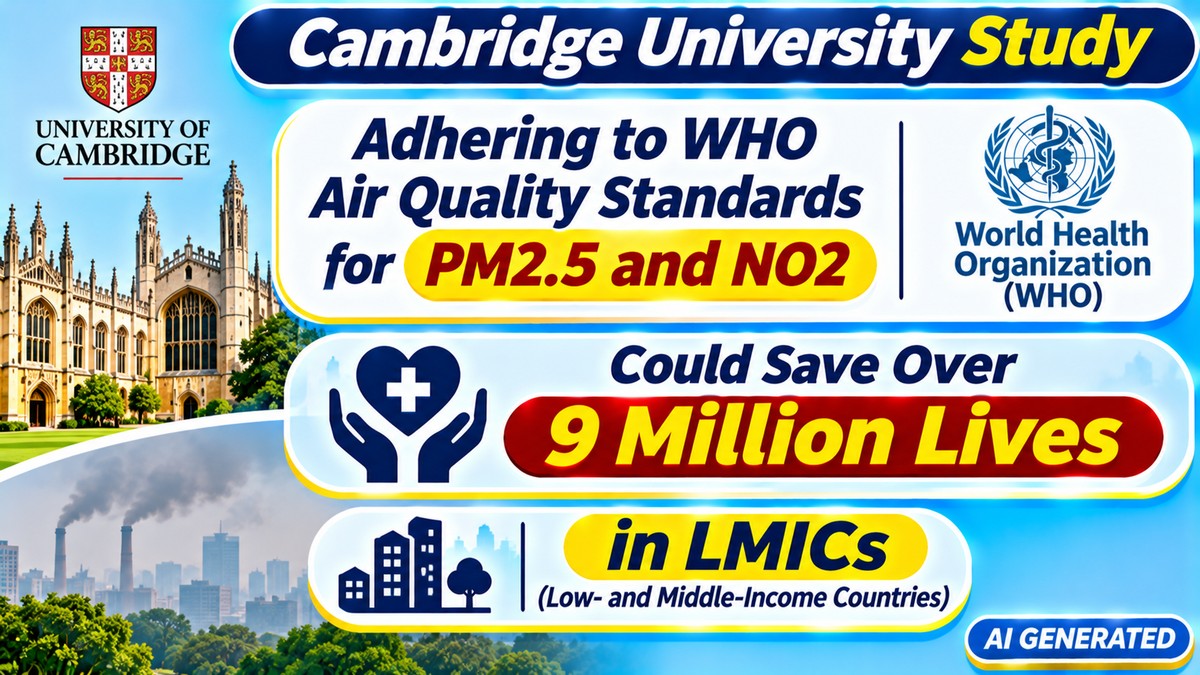
Adhering to WHO Air Quality Standards Could Save 9 Million Lives: Study
Why in the News?
A new study led by researchers from the University of Cambridge indicates that adhering to the World Health Organization's (**WHO**) recommended annual air quality guidelines could save **over 9 million lives** in low- and middle-income countries (LMICs).
Key Features / Major Points:
- WHO Safe Thresholds:
- The UN health agency prescribes a maximum annual mean level of **5 micrograms per cubic meter (µg/m³) for PM2.5** and **10 µg/m³ for Nitrogen Dioxide (NO2)**.
- Major Pollutants Explained:
- **PM2.5 (particulate matter ≤ 2.5 microns):** Fine particles capable of penetrating deep into lungs, sourced primarily from vehicle exhaust, industrial activities, and construction dust.
- **NO2:** A key gaseous pollutant primarily released during fossil fuel combustion.
- Socio-Economic Impact:
- Rapid urbanization and motor vehicle growth in LMICs have degraded air quality, driving up cardiovascular and respiratory illnesses.
- Compliance with WHO guidelines reduces healthcare burdens, decreases work absenteeism, and boosts overall economic productivity.
---
Static GK Facts:
- World Health Organization (WHO):
- Formed: **April 7, 1948** (Observed as World Health Day) | Headquarters: **Geneva, Switzerland**.
- Director-General: Tedros Adhanom Ghebreyesus.
- India's National Air Quality Index (AQI):
- Launched in 2014, monitoring **8 major pollutants** (PM10, PM2.5, NO2, SO2, CO, O3, NH3, Pb).
One-Liner Quiz (All Competitive Exams):
Q: According to a Cambridge University study, how many lives can be saved in LMICs by adhering to WHO air quality standards?
A: Over 9 million lives
Q: What is the WHO's recommended maximum annual limit for PM2.5 concentration?
A: 5 µg/m³
Q: Where is the headquarters of the World Health Organization (WHO) located?
A: Geneva, Switzerland
#WHO #AirQuality #PM25 #NO2 #PublicHealth #CambridgeUniversity #CurrentAffairs #StaticGK