National 21 November 2026
Revised Disability Assessment Guidelines Issued; Dwarfism Included
Why in the News?
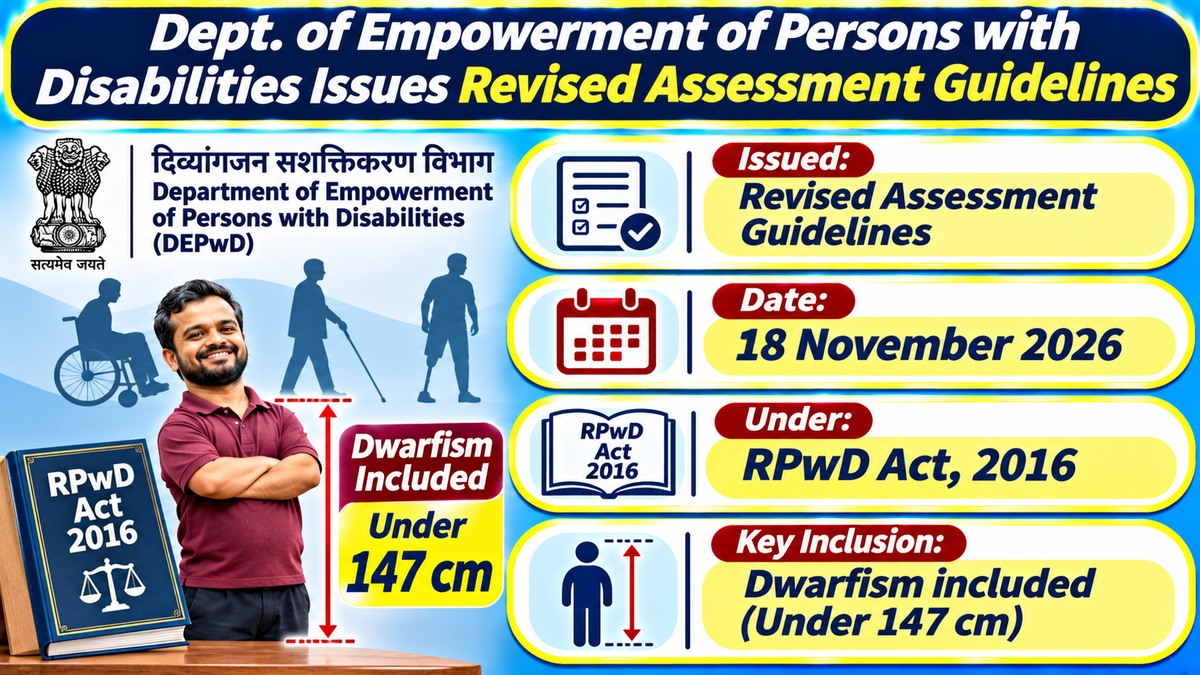
On November 18, 2026, the Department of Empowerment of Persons with Disabilities issued revised disability assessment guidelines under the Rights of Persons with Disabilities (RPwD) Act, 2016, replacing the March 2024 standards. The updated framework explicitly includes dwarfism, defining affected adults as those with a height below 147 cm (4 feet 8 inches).
Key Highlights:
* Dwarfism & Locomotor Disability:
* Adults shorter than 147 cm (4 feet 8 inches) fall under dwarfism, with each 1-inch shortfall counted as 4% permanent locomotor disability (associated bone deformities assessed separately).
* Non-amputation cases receive temporary certificates after 6 months of symptoms and permanent certificates after turning 18, with reassessment every 10 years on request or specialist recommendation.
* Major Categories & Assessment Benchmarks:
* Visual Impairment: Blindness (best-eye acuity below 3/60 after best possible correction or field of vision less than 10 degrees) and low vision (acuity below 6/18 to 3/60 or field below 40 degrees to 10 degrees).
* Hearing, Speech & Language: Hearing measured via pure-tone audiometry at 500, 1000, 2000, and 4000 Hz; speech/language covers laryngectomy, glossectomy, bilateral vocal cord paralysis, dysarthria, and apraxia of speech.
* Intellectual Disability & Autism: Global Developmental Delay (GDD) for ages over 1 to 5 and intellectual disability above age 5 (borderline 25% to profound 100%); autism assessed via AIIMS-modified INCLEN tool and the ISAA scale for ages 6 and above (40% at score 70 up to 100% above 153; below 70 indicates no autism).
* Specific Learning Disability & Mental Illness: Learning disability requires IQ 85 or above and persistent difficulties for at least 6 months (NIMHANS and NIEPID tools); mental illness uses IDEAS (mild 25% to profound 100%), generally requiring 2 years for permanent certification.
* Blood Disorders, Multiple & Neurological Conditions: 40% benchmark disability for severe haemophilia, thalassaemia major/intermedia, or sickle cell disease meeting specified criteria; multiple disability combines conditions of 25% or more up to a 100% cap; epilepsy ranges from 0% (single seizure) to 75% (more than 10 seizures/month), with the Director General of Health Services deciding interpretive doubts.
---
Static GK Facts:
* Rights of Persons with Disabilities Act, 2016:
* Replaced the Persons with Disabilities (Equal Opportunities, Protection of Rights and Full Participation) Act, 1995.
* Expanded specified disability categories from 7 to 21.
* Nodal Department & UDID:
* Nodal Body: Department of Empowerment of Persons with Disabilities (under the Ministry of Social Justice and Empowerment).
* UDID: Unique Disability Identification card for persons with disabilities.
* Key Assessment Institutions:
* NIMHANS: National Institute of Mental Health and Neurosciences (Bengaluru).
* NIEPID: National Institute for the Empowerment of Persons with Intellectual Disabilities (Secunderabad).
One-Liner Quiz (All Competitive Exams):
Q: Under the revised guidelines, adults below what height are included in the definition of dwarfism?
A: Below 147 cm (4 feet 8 inches)
Q: Which Act governs the revised disability assessment guidelines issued in November 2026?
A: Rights of Persons with Disabilities (RPwD) Act, 2016
Q: Which scale is used to assess autism in individuals aged six years and above?
A: Indian Scale for Assessment of Autism (ISAA)
#RPwDAct #DisabilityGuidelines #Dwarfism #Divyangjan #CurrentAffairs #StaticGK