
Science & Tech 04 September 2026
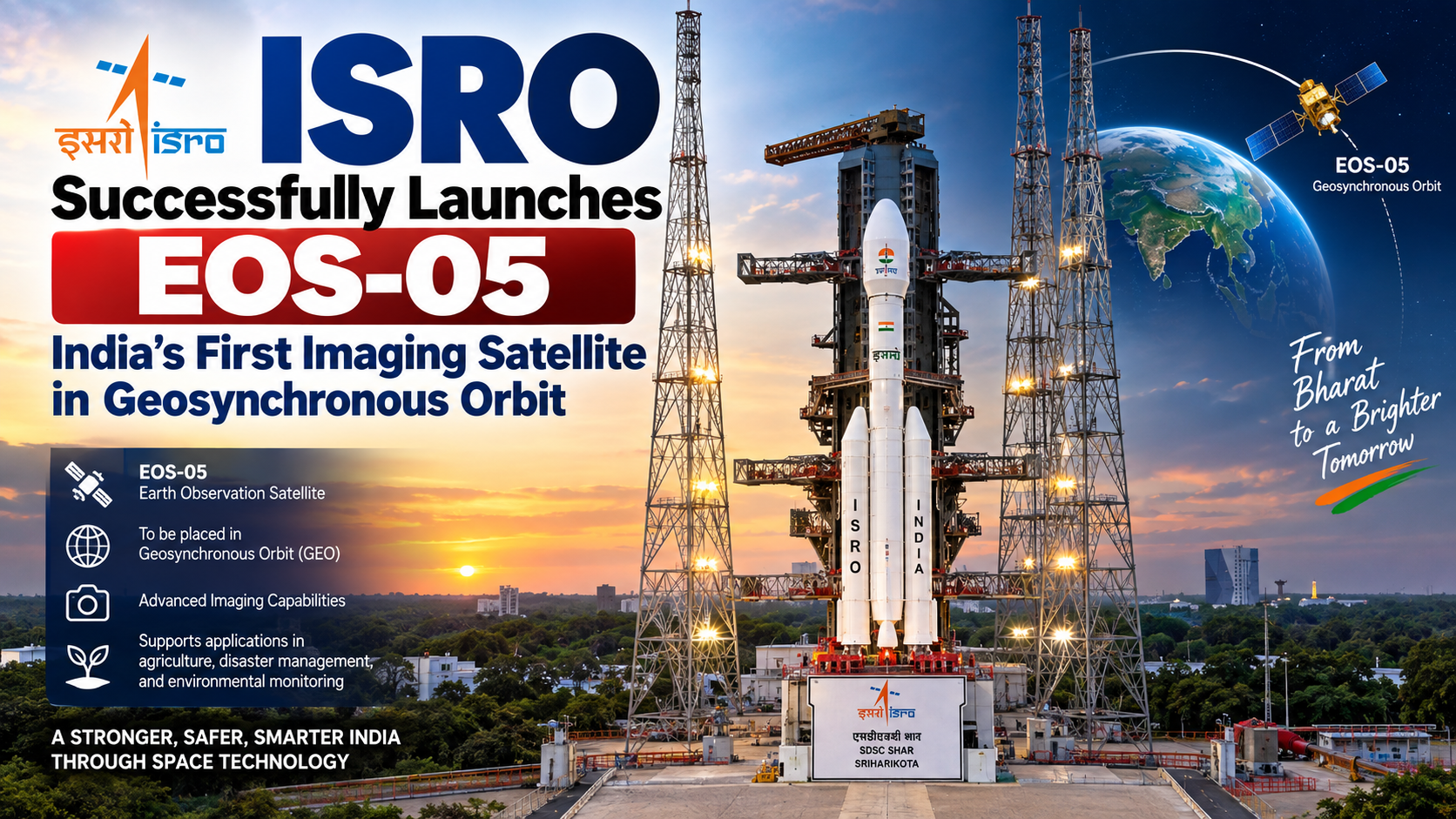
ISRO Successfully Launches EOS-05: India's First Imaging Satellite in Geosynchronous Orbit
Why in the News?
The Indian Space Research Organisation (ISRO) successfully launched EOS-05, the country’s first-ever Earth observation imaging satellite designed for geosynchronous orbit, aboard the GSLV-F17 rocket from Sriharikota.
Key Features / Major Points:
Mission Objective: Positioned at an altitude of approximately 36,000 km, EOS-05 will match Earth's rotational speed to deliver continuous real-time imagery for agriculture, disaster management, and weather tracking.
Launch Vehicle: The GSLV-F17 marks the 19th flight of India’s Geosynchronous Satellite Launch Vehicle, featuring a 3-stage configuration with an indigenous Cryogenic Upper Stage.
Payload Mass: The EOS-05 satellite weighs 2,367 kg and was deployed into a Sub-Geosynchronous Transfer Orbit (Sub-GTO).
Replacement Mission: This launch serves as a replacement for the unsuccessful GSLV-F10/EOS-03 mission of 2021.
Static GK Facts:
ISRO (Indian Space Research Organisation): Formed: August 15, 1969 | Headquarters: Bengaluru, Karnataka.
Satish Dhawan Space Centre (SDSC): Location: Sriharikota, Andhra Pradesh (India's primary spaceport).
Geosynchronous Orbit (GEO): An orbit located at roughly 35,786 km above Earth's equator where the satellite's orbital period matches Earth's rotational period.
One-Liner Quiz (All Competitive Exams):
Q: Which launch vehicle was used by ISRO to launch EOS-05, India's first geosynchronous imaging satellite?
A: GSLV-F17
Q: In which Indian state is the Satish Dhawan Space Centre located?
A: Andhra Pradesh (Sriharikota)
Q: Where is the headquarters of ISRO located?
A: Bengaluru