
Land & Environment 20 November 2026
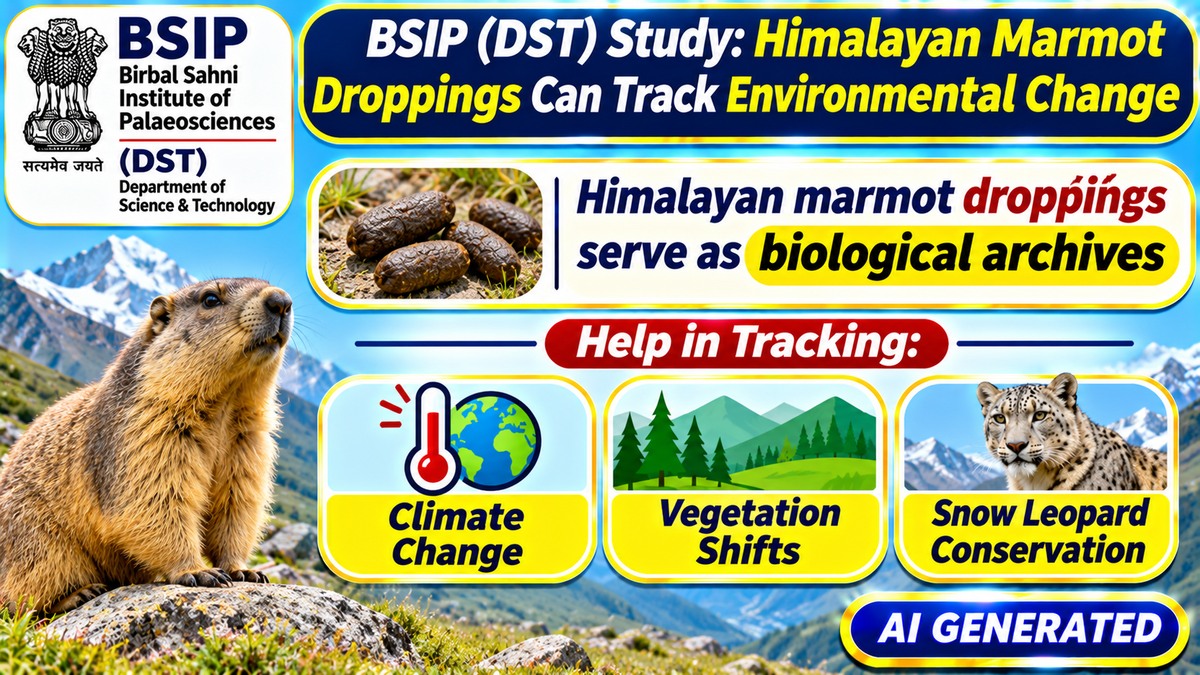
Himalayan Marmot Droppings Offer New Clues to Climate Change and Alpine Ecosystem Shifts: BSIP Study
Why in the News?
A new study by scientists from the **Birbal Sahni Institute of Palaeosciences (BSIP)**, an autonomous institute under the Department of Science and Technology (DST), reveals that the droppings of the **Himalayan marmot (*Marmota himalayana*)** can serve as a vital biological archive for understanding climate change, vegetation patterns, and environmental shifts in the higher Himalaya.
Key Features / Major Points:
- Publication & Methodological Scope:
- Published in the journal **'PLOS ONE'**, providing an alternative palaeoenvironmental archive in remote, arid mountain regions where lake sediments, peat, and soil are scarce.
- Scientific Techniques & Palynological Analysis:
- Lead researchers (Sadhan K. Basumatary, Hukam Singh, Manish Mehta, Swati Tripathi, et al.) analyzed preserved **pollen grains**, **fungal spores**, and **elemental signatures (FESEM–EDS)**.
- Identified major plant groups in the marmot diet, including *Artemisia*, *Asteroideae*, *Caryophyllaceae*, *Poaceae*, *Cyperaceae*, and *Chenopodiaceae*.
- Examined pollen combination ratios (*Artemisia* to *Chenopodiaceae*, *Cyperaceae*, and *Ephedra*) to construct a modern reference framework for future palaeoecological coprolite studies.
- Relevance to Snow Leopard Conservation:
- The Himalayan marmot is a primary prey species for the elusive **Snow Leopard**.
- Tracking marmot population dynamics and habitat altitudinal shifts provides essential ecological data for apex predator conservation and high-altitude food chain management.
---
Static GK Facts:
- Birbal Sahni Institute of Palaeosciences (BSIP):
- Founded: **1946** (by Prof. Birbal Sahni) | Location: **Lucknow, Uttar Pradesh** (operates under DST).
- Himalayan Marmot (*Marmota himalayana*):
- Habitat: High-altitude cold, dry alpine-steppe regions | IUCN Red List Status: **Least Concern**.
- Snow Leopard (*Panthera uncia*):
- State Animal of Ladakh & Himachal Pradesh | IUCN Status: **Vulnerable**.
One-Liner Quiz (All Competitive Exams):
Q: Which Indian autonomous research institute under DST led the study analyzing Himalayan marmot droppings for climate change research?
A: Birbal Sahni Institute of Palaeosciences (BSIP, Lucknow)
Q: What is the scientific name of the Himalayan marmot?
A: *Marmota himalayana*
Q: The ecological study of Himalayan marmots directly supports the conservation of which major high-altitude predator?
A: Snow Leopard (*Panthera uncia*)
#HimalayanMarmot #BSIP #ClimateChange #PLOSONE #SnowLeopard #CurrentAffairs #StaticGK