
Science & Tech 24 November 2026
IIA Astronomers Study Rare Stellar Fossil HE 1153−0518 to Uncover Universe's First Stars
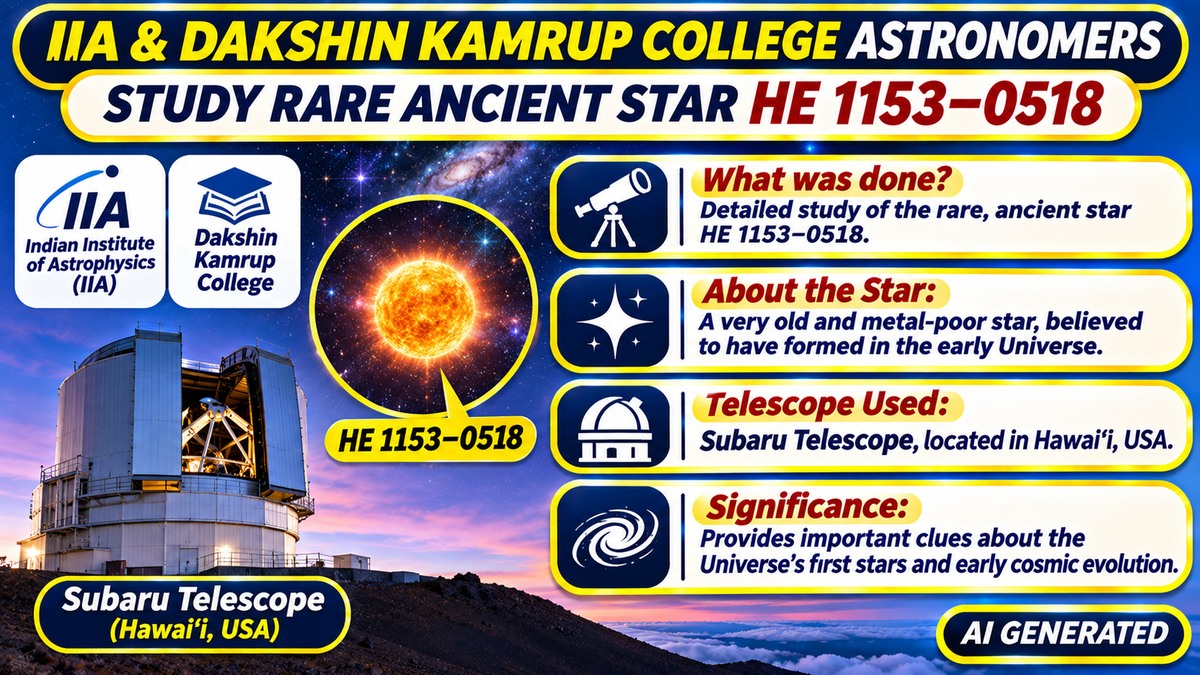
Why in the News?
Astronomers from the **Indian Institute of Astrophysics (IIA)**, Bengaluru—an autonomous institute under the Department of Science and Technology (DST)—and Dakshin Kamrup College, Assam, studied a rare ancient star named **HE 1153−0518**, whose chemical composition acts as a "stellar fossil" preserving signatures of the Universe's earliest generations of stars.
Key Highlights:
- Understanding Stellar Fossils:
- The Universe's first generation of massive stars formed a few hundred million years after the Big Bang and ended in supernova explosions, enriching primordial gas with synthesized elements.
- Ancient, metal-poor stars formed from this gas preserve chemical records of nucleosynthesis that occurred over 13 billion years ago.
- Characteristics of HE 1153−0518:
- Classified as a **Carbon-Enhanced Metal-Poor (CEMP-no)** star—rich in carbon and sodium, but severely deficient in iron (~1/1,000th of the Sun's iron abundance) and heavy elements produced via neutron-capture processes.
- Measured a low carbon isotopic ratio (¹²C/¹³C) indicating internal mixing, with excess infrared emission suggesting circumstellar dust.
- Research Team & Publication:
- **Lead Authors:** Partha Pratim Goswami (Dakshin Kamrup College) and Aruna Goswami (IIA).
- **Telescope Used:** High-resolution spectroscopic data gathered using the **Subaru Telescope** in Hawaii.
- **Published In:** *Monthly Notices of the Royal Astronomical Society (MNRAS)*.
---
Static GK Facts:
- Indian Institute of Astrophysics (IIA):
- Location: **Bengaluru, Karnataka** (Autonomous institute under DST, Govt of India).
- Subaru Telescope:
- Location: **Mauna Kea Observatory, Hawaii (USA)** | Operated by: **National Astronomical Observatory of Japan (NAOJ)**.
- CEMP-no Stars:
- Carbon-Enhanced Metal-Poor stars with no heavy neutron-capture elements; vital for reconstructing Galactic chemical evolution.
One-Liner Quiz (All Competitive Exams):
Q: Which rare ancient CEMP-no star was recently studied by IIA and Dakshin Kamrup College astronomers?
A: HE 1153−0518
Q: High-resolution spectroscopic data for star HE 1153−0518 was collected using which Hawaii-based telescope?
A: Subaru Telescope
Q: In which astronomical journal was the research on stellar fossil HE 1153−0518 published?
A: Monthly Notices of the Royal Astronomical Society (MNRAS)
#Astronomy #HE11530518 #StellarFossils #IIABengaluru #SubaruTelescope #MNRAS #CurrentAffairs #StaticGK