Science & Tech 04 November 2026
Aditya-L1 Uncovers Asymmetric Expansion of Solar Eruption, Offers New Insights into Space Weather
Why in the News?
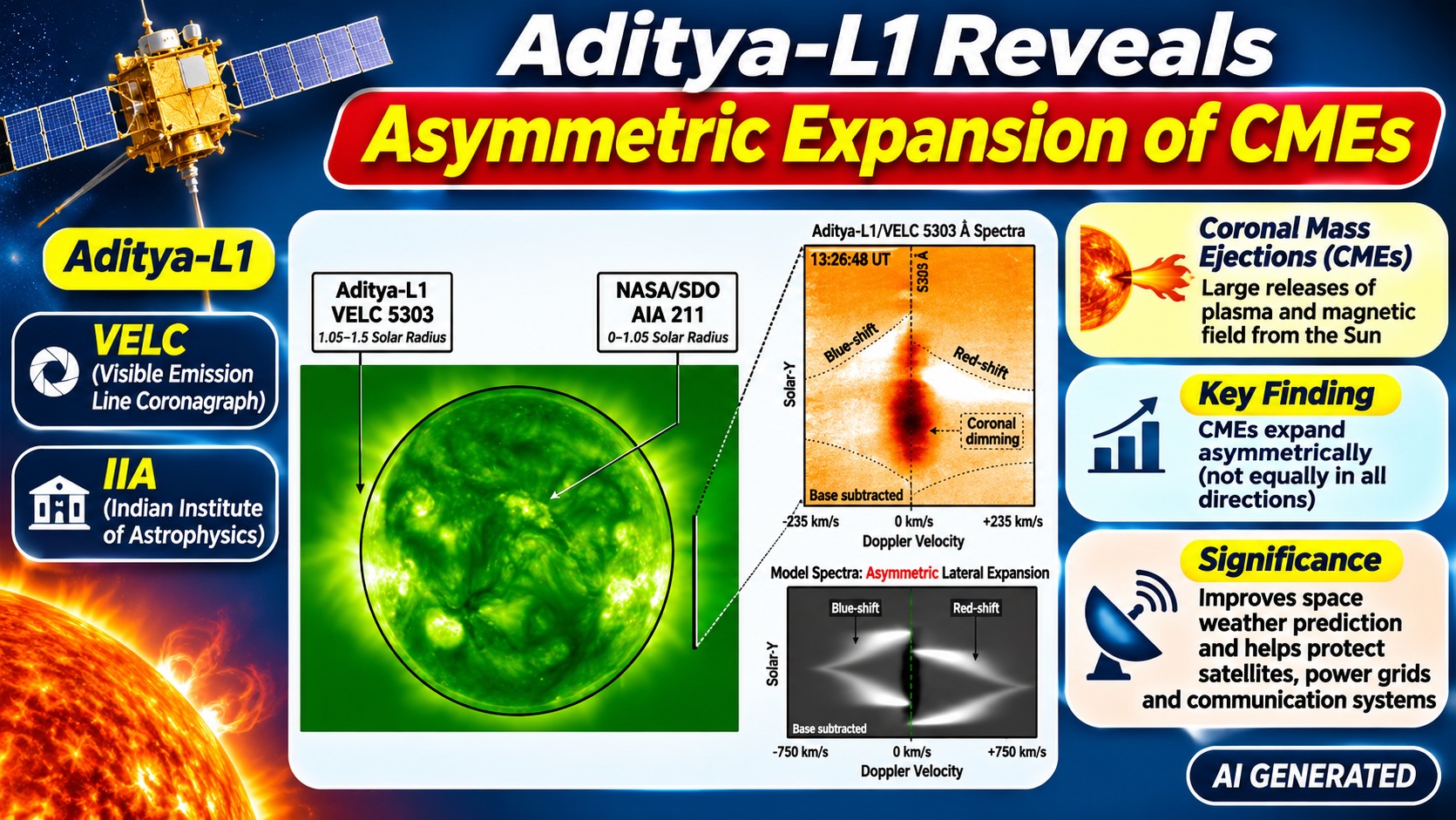
India's premier space-based solar observatory, **Aditya-L1**, has provided groundbreaking insights into solar eruptions. Research led by the Indian Institute of Astrophysics (IIA) revealed that **Coronal Mass Ejections (CMEs)** do not expand uniformly as symmetrical bubbles but instead develop an **asymmetric shape**.
Key Features / Major Points:
- Research & Discovery (Published in *The Astrophysical Journal Letters*):
- Analyzing a CME that occurred on August 5, 2024, IIA scientists combined data from Aditya-L1's **VELC**, NASA's **Solar Dynamics Observatory (SDO)**, and 3D geometric-kinematic modeling.
- VELC’s spectroscopic observations recorded Doppler shifts (blueward and redward shifts) to map line-of-sight plasma motion, confirming non-uniform lateral expansion and an inclined CME axis.
- Core Role of VELC Payload:
- Designed and built by **IIA (Hosakote, Bengaluru)** with support from ISRO, the Visible Emission Line Coronagraph (**VELC**) studies the solar corona in the 530.3-nanometer green emission line.
- Implications for Space Weather Forecasting:
- Understanding non-uniform CME expansion will refine predictions of CME travel speeds, solar wind interactions, arrival times at Earth, and potential disruptions to satellite operations, communication networks, and power grids.
---
Static GK Facts:
- Aditya-L1 Mission Overview:
- Launch Date: **September 2, 2023** (via PSLV-C57) | Orbit: Halo Orbit around **Sun-Earth L1 Point**.
- Total Payloads: **7** (Primary Payload: VELC).
- Indian Institute of Astrophysics (IIA):
- Headquarters: **Bengaluru, Karnataka** (Autonomous institute under the Department of Science and Technology).
- ISRO (Indian Space Research Organisation):
- Established: **August 15, 1969** | Headquarters: **Bengaluru**.
One-Liner Quiz (All Competitive Exams):
Q: Which primary payload of Aditya-L1 detected the asymmetric expansion of solar coronal mass ejections (CMEs)?
A: VELC (Visible Emission Line Coronagraph)
Q: At which orbital location is India's solar observatory Aditya-L1 positioned?
A: Sun-Earth L1 Point (Lagrange Point 1)
Q: Which Indian autonomous institute developed the VELC payload onboard Aditya-L1?
A: IIA (Indian Institute of Astrophysics, Bengaluru)
#AdityaL1 #ISRO #IIA #VELC #SpaceWeather #SunEruption #CurrentAffairs #StaticGK